


Improving Your Range of Motion: How Chiropractic Care Restores Mobility

You wake up and reach for the alarm, but your neck catches with a sharp tug. Later, you're merging onto the highway and realize you have to rotate your entire torso just to check your blind spot because your neck simply won't turn. It is a frustrating feeling that makes you feel much older than you actually are. You aren't alone in feeling "stuck" in your own body, and you shouldn't have to accept it as your new normal.
Stiffness often comes down to joint mechanics that have drifted out of alignment. Finding a chiropractor for range of motion is a practical way to address these restrictions at the source. At Enrich Chiropractic, we believe your care should be as straightforward as a conversation with a neighbor. You deserve to move freely without the pressure of long-term contracts or complex memberships. We focus on your immediate needs to get you back to your life quickly.
In this article, you'll learn how targeted adjustments can unlock your joints and restore your natural mobility. We'll cover the specific ways chiropractic care reduces muscle tension and helps you get back to your daily tasks. We are focused on providing an honest, clear path to better movement so you can stop feeling limited and start feeling like yourself again.
Table of Contents
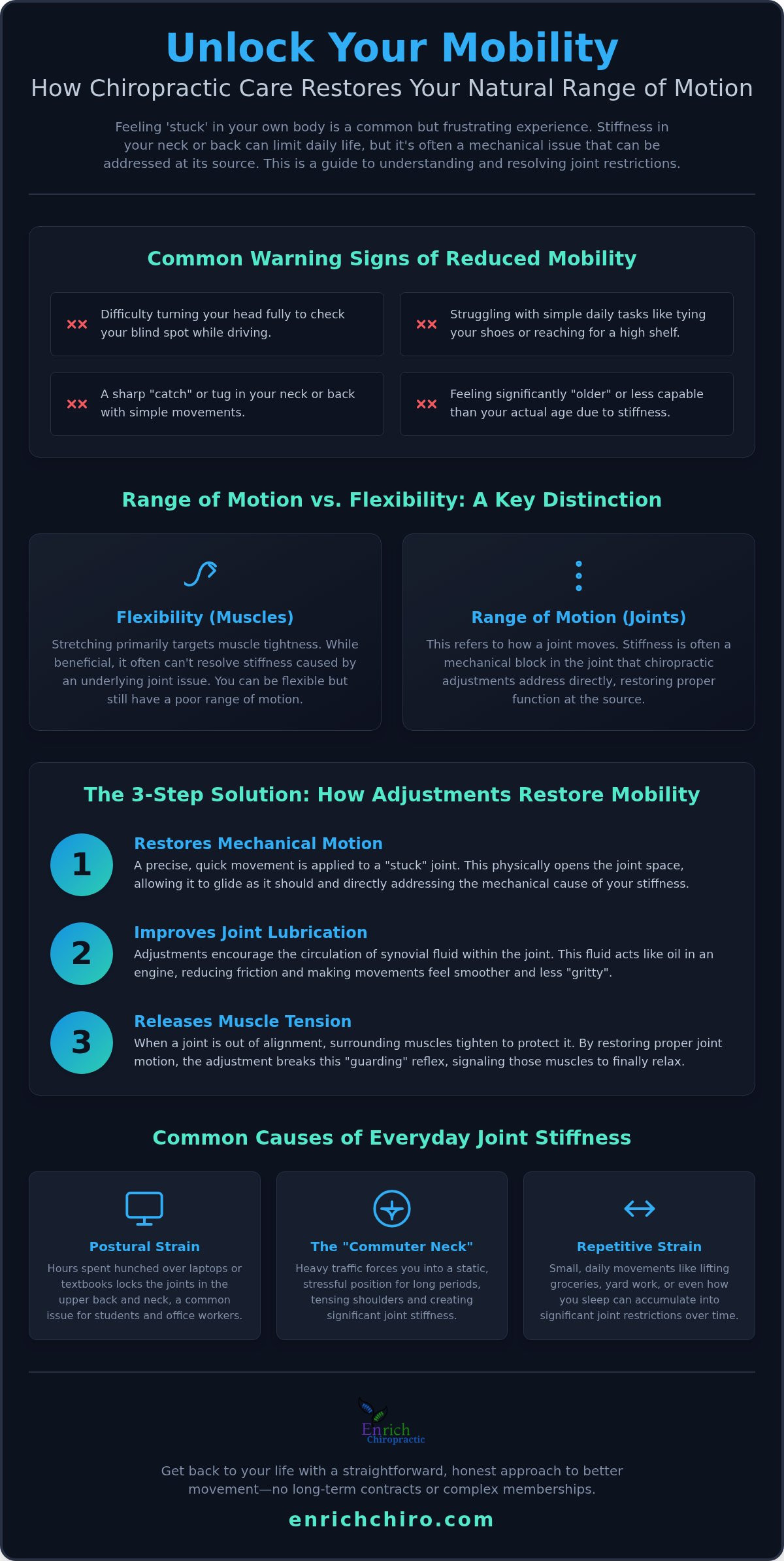
Understanding Range of Motion: Why Your Body Feels 'Stuck'
Range of Motion, or ROM, is the measurement of movement around a specific joint or body part. It is the primary way we determine how well your body is actually functioning. There are two distinct types you should understand: active and passive. Active ROM is the distance you can move a limb using your own muscle power. Passive ROM is the distance that joint can travel when an outside force, like a doctor, moves it for you. Often, your passive ROM is greater than your active ROM. This difference tells us a lot about your muscle health and joint alignment.
Most people feel this "stuck" sensation in two main hotspots. The cervical spine, or your neck, is a common area where people lose the ability to turn or tilt. The lumbar region, your lower back, is the other frequent culprit. When you see a chiropractor for range of motion, the goal is to identify exactly where these measurements are falling short. It's important to realize that a joint restriction is a mechanical block within the joint structure that stretching your muscles simply cannot fix.
The Hidden Costs of Reduced Mobility
When one joint stops moving correctly, your body doesn't just give up. It compensates. Other muscles and joints have to work much harder to make up the difference. This chain reaction often leads to secondary injuries in areas that were originally healthy. For example, a stiff neck might eventually lead to shoulder pain or headaches as your body tries to find a way to move. It's a frustrating cycle that can limit your entire lifestyle.
There is also a real psychological toll. Losing your mobility makes you feel "old" or "stuck" regardless of your actual age. It's discouraging to struggle with simple tasks like reaching for a high shelf or tying your shoes. Beyond that, it creates safety risks. If you can't turn your head fully to check your blind spot while driving on Cobb Parkway, you are facing a dangerous situation every time you get behind the wheel. Restoring that motion isn't just about comfort. It's about staying safe and confident in your daily life.
Common Causes of Joint Stiffness in Kennesaw Residents
Living in Kennesaw presents specific challenges to your mobility. Many of these issues start small but grow over time through repetitive habits. Here are the most common factors we see:
Postural strain: We see many Kennesaw State University students who spend hours hunched over laptops or textbooks. This position locks the joints in the upper back and neck.
The Commuter Neck: Heavy traffic on I-75 and Highway 41 forces you into a static, stressful position for long periods. Holding a steering wheel while tensing your shoulders creates significant joint stiffness.
Repetitive strain: Small, daily movements like lifting groceries, yard work, or even how you sleep can accumulate into significant joint restrictions over time.
These factors combine to create a general feeling of being trapped in a body that won't cooperate. Identifying these causes is the first step toward finding a straightforward solution that works for your schedule and your lifestyle. You don't have to live with a body that feels like it's working against you.
How Chiropractic Adjustments Restore Mobility and Flexibility
A manual adjustment is a precise, quick movement applied to a specific joint. When a vertebral segment is "stuck," it doesn't move through its full path. This causes the joint to become stiff and inflamed. A chiropractor for range of motion uses these adjustments to restore that lost movement. By physically opening the joint space, we allow the segment to glide as it should. This is the most direct way to address the mechanical cause of your stiffness.
Proper motion is also about lubrication. Your joints are filled with synovial fluid. This fluid acts like oil in an engine. When a joint is restricted, the fluid doesn't circulate well. Adjustments encourage this fluid to flow, coating the joint surfaces and reducing friction. This makes every movement feel smoother and less "gritty" when you turn your head or bend over.
Your body also has a natural "guarding" reflex. When a joint is out of alignment, the surrounding muscles tighten up to protect the area. This muscle tension actually makes the stiffness worse. Adjustments break this cycle. Once the joint is moving again, the nervous system tells those muscles they can finally relax. This is why you often feel a sense of lightness and ease immediately after a session.
You might feel an immediate "release" after your first visit. However, mobility gains are often cumulative. Think of it like a rusty hinge. The first drop of oil helps, but regular movement ensures it stays loose. If you're ready to start this process, you can schedule a standard chiropractic adjustment to see how your body responds without any long-term pressure.
The Science of the 'Pop': Cavitation and Motion
That popping sound you often hear is called cavitation. It's simply the release of gas bubbles, mostly nitrogen and carbon dioxide, from the joint fluid. It's a pressure change, not bones rubbing together. While the sound is common, it isn't actually necessary for the treatment to work. The real goal is the restoration of motion, whether you hear a pop or not. This is a controlled, professional procedure that is much safer and more effective than trying to "crack" your own back or neck at home.
Neurological Benefits: Beyond the Bone
Adjustments do more than just move bone. They stimulate mechanoreceptors, which are tiny sensors in your joints that talk to your brain. This stimulation helps "reset" your nervous system's perception of pain and tension. When your spine is aligned, your body moves more efficiently. You don't have to fight against your own stiffness to perform daily tasks. This saves energy and makes simple movements feel effortless again. A properly aligned spine is the foundation for a body that moves without resistance.
Range of Motion vs. Flexibility: Why Stretching Isn't Always Enough
People often use the terms "flexibility" and "mobility" as if they mean the same thing. They don't. Flexibility is strictly about your muscles. It's the ability of those soft tissues to lengthen and stretch. Mobility is about the joint itself. It's the ability of a joint to move through its intended spectrum of motion. If your joint is mechanically stuck, no amount of muscle stretching will fix the underlying problem. You're trying to solve a hardware issue with a software update.
Stretching a muscle that is attached to a restricted joint often provides only temporary relief. It feels good for an hour, but the stiffness returns quickly. Think of it this way: stretching is like pulling on a rubber band. Chiropractic care is like fixing the hinge that the rubber band is attached to. If the hinge is rusty and locked, pulling the rubber band won't make the door swing any easier. A chiropractor for range of motion focuses on the hinge first. Once the joint moves, the muscles can finally stay relaxed.
The 'Locked Hinge' Problem
We see many athletes in Acworth and Woodstock who hit "plateaus" in their training. They spend thirty minutes stretching every day but can't seem to get deeper into a squat or reach further overhead. This happens because joint restrictions create a hard "ceiling" for your movement. Your brain is smart. It won't let a muscle lengthen if it senses the underlying joint is unstable or stuck. It keeps the muscle tight as a protective measure. Professional adjustments work in synergy with your home exercises. By removing the joint restriction, you lower that ceiling. This allows your home-based mobility work to actually produce results instead of just providing a few minutes of relief.
When to Stop Stretching and See a Professional
There are clear warning signs that your stiffness is structural rather than just muscular. If you feel a sharp, localized pinch during a stretch, that's your body telling you the joint is the issue. Pushing through that pain can be counterproductive. There is also a real danger in "over-stretching." Sometimes, people stretch a healthy, loose joint to compensate for a stuck one nearby. This creates instability and can lead to a new injury.
If you find yourself stretching the same spot every single day with no lasting change, it's time for a different approach. Localized pain during a simple movement often suggests a need for a manual adjustment chiropractor Kennesaw. We provide a straightforward assessment to see if your joints are the real culprit. We don't use high-pressure tactics or require long-term commitments. We just want to help you find the most efficient path back to moving comfortably.
Signs Your Mobility Issues Require Professional Chiropractic Care
You shouldn't have to wait for a major injury to realize your body isn't moving right. Small signs usually show up first. One of the most common is difficulty looking over your shoulder while merging into traffic. If you find yourself leaning forward or twisting your whole body just to see your blind spot, your neck joints are likely restricted. Seeing a chiropractor for range of motion can help identify these mechanical blocks before they lead to a more serious strain.
Another sign is the "cheat" posture. This happens when you can't reach overhead or behind your back without arching your spine or shrugging your shoulders. Your body is trying to make up for a lack of joint motion by using other parts of your frame. You may also need stiff neck relief Woodstock residents often seek when heat and rest aren't enough. If a hot shower or a weekend off doesn't loosen you up, the problem is likely deeper than a tired muscle. Feeling a "catch" or a sharp pinch during normal movement is another clear signal. That sudden stop in motion is your body's way of protecting a joint that isn't tracking correctly.
Mobility for the Modern Professional and Student
We see a lot of "Tech Neck" in KSU students and remote workers in Marietta. Spending hours hunched over a laptop or textbook rounds the shoulders and locks the mid-back. Over time, poor ergonomic setups can lead to a permanent loss of thoracic mobility. You can do a simple "desk check" right now. Sit tall and try to rotate your torso to the left and right without moving your hips. If you feel a hard stop or a sharp tightness in your ribs, your mid-back joints are restricted. Addressing this early keeps your posture from becoming permanently fixed in a slumped position.
The 'Weekend Warrior' Mobility Gap
The "Weekend Warrior" mobility gap is a real risk for active people in Woodstock or Acworth. If you sit at a desk all week and then try to play eighteen holes of golf or hike Kennesaw Mountain, your body might not be ready. Limited range of motion in your hips and spine forces your knees and lower back to take the extra strain. This is often where sports-related injuries begin. A chiropractor for range of motion provides the maintenance care needed to keep your joints moving freely. Better hip and spine mobility directly improves your performance in local golf, tennis, or hiking by allowing your body to rotate and absorb impact efficiently.
If these signs sound familiar, don't ignore them. We offer a straightforward first visit consultation and adjustment to help you get back to your daily tasks with ease. We focus on personal attention and honest care to get you moving again without any long-term pressure.
Regaining Your Mobility at Enrich Chiropractic in Kennesaw
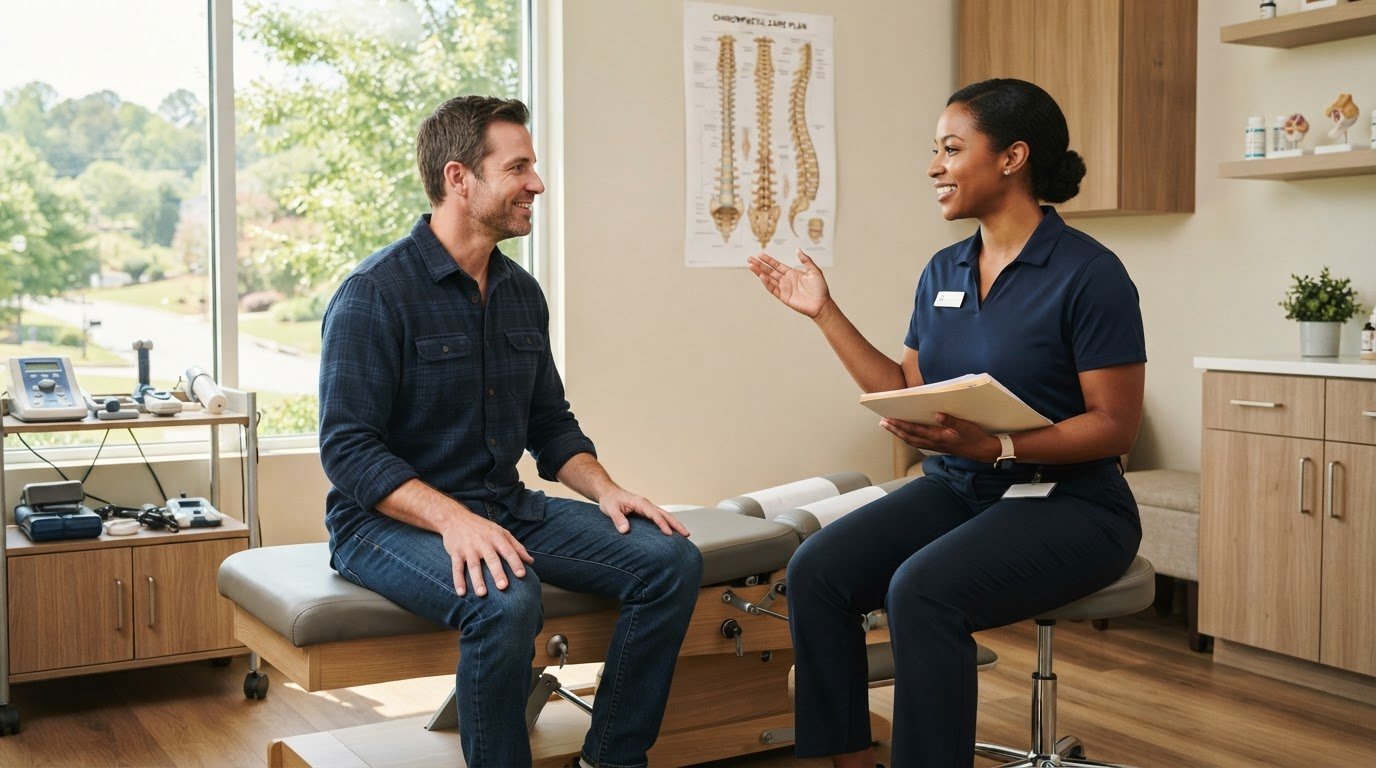
Dr. Rich offers a personalized experience that you won't find in a corporate clinic. At Enrich Chiropractic, we focus on one-on-one care. You aren't just a number in a high-volume system. We take the time to understand your specific stiffness and mobility goals. Choosing the right chiropractor for range of motion means finding someone who listens to your concerns. Dr. Rich provides tailored adjustments that respect your body and your time. He is a local expert who acts as a guide for your recovery.
Our approach is built on honesty and simplicity. We don't use complex medical jargon to explain your discomfort. Instead, we offer straightforward solutions that make sense. We serve neighbors in Kennesaw, Marietta, Acworth, and Woodstock. Our goal is to get you back to your daily life without any unnecessary hurdles. We believe that professional care should feel like a conversation with a trusted neighbor.
No Contracts, No Memberships, Just Relief
We operate on a simple pay-per-visit model. This means you only pay for the care you need when you actually need it. We don't require long-term contracts or monthly membership fees. This transparency builds a foundation of trust from the very first visit. It also makes it easier to access an affordable sciatica treatment Marietta residents can rely on. You get high-quality care without the financial stress of a subscription.
Many people avoid care because they fear being locked into a six-month treatment schedule. We've eliminated that anxiety. You are in control of your health and your budget. If you feel better after one session, that's great. If you need a few more visits to fully restore your mobility, we're here to help. There is no pressure and no aggressive sales pitch. We focus on your results, not our volume.
Convenient Care for Busy Georgia Lifestyles
Life in North Georgia is fast-paced. Between work, school, and family, finding time for self-care is difficult. We've designed our practice to be as accommodating as possible. We are open on Sundays to serve busy professionals and weekend warriors. This allows you to get the relief you need without missing work or class. It's a common-sense approach to healthcare that fits your actual schedule.
We also offer walk-ins and same-day appointments. If you wake up with a "stuck" neck or a sharp catch in your back, you don't have to wait days for an opening. We prioritize getting you into the office quickly. We invite you to experience an honest first visit in Kennesaw. It's a low-pressure way to see how targeted care can improve your quality of life. Better mobility is within reach; it starts with a simple, straightforward conversation.
Start Moving with Confidence and Ease
You don't have to accept a "stuck" feeling as a permanent part of your life. Restoring your mobility is about more than just stretching; it's about ensuring your joints are mechanically aligned and lubricated. When you visit a chiropractor for range of motion, you're addressing the root cause of your stiffness rather than just chasing symptoms. At Enrich Chiropractic, we focus on providing a clear and honest path back to your natural movement. We prioritize your comfort by offering one-on-one care with Dr. Rich in a relaxed, local environment.
We believe that high-quality care should be straightforward and low-pressure. That's why we never require long-term contracts or memberships. You simply pay for the care you need when you need it. We're even open on Sundays to accommodate your busy work or school schedule. If you're ready to stop feeling limited by your own body, we're ready to help you find relief.
Book Your First Visit with Dr. Rich - Only $60 for Consultation & Adjustment
You deserve to wake up without a stiff neck and drive without struggling to check your blind spot. Let's work together to restore your mobility so you can get back to the activities you love. We look forward to helping you move better soon.
Frequently Asked Questions
Can a chiropractor really help with my range of motion?
Yes. Chiropractic adjustments specifically target joint restrictions that prevent full movement. While stretching focuses on muscles, a chiropractor for range of motion addresses the mechanical alignment of the joint itself. By restoring proper motion to "stuck" segments in your spine or limbs, we reduce inflammation and allow the joint to glide smoothly. This often results in an immediate feeling of lightness and improved mobility.
How many sessions will I need to see an improvement in my mobility?
Many patients notice an improvement after their very first adjustment. However, mobility is often a cumulative process. The number of visits depends on how long you've been stiff and your daily habits, like long commutes on I-75. We don't use long-term contracts, so we evaluate your progress at every visit. Our goal is to get you moving comfortably in the fewest visits possible without any high-pressure sales tactics.
Is it normal to feel sore after a mobility adjustment?
Mild soreness is a common and normal response after your first few adjustments. Think of it like the "good" soreness you feel after starting a new exercise routine. Your body is adapting to new positions and restored joint movement. This sensation usually fades within 24 to 48 hours. We recommend staying hydrated and moving gently to help your muscles relax as they adjust to your improved alignment.
Do I need to sign a contract for chiropractic care at Enrich?
No. We never require long-term contracts or monthly membership subscriptions. At Enrich Chiropractic, we believe you should only pay for the care you actually need. You are in control of your treatment schedule and your budget. This straightforward, pay-per-visit model ensures that our focus remains entirely on your recovery and comfort rather than on meeting corporate sales quotas or long-term financial commitments.
Are chiropractic adjustments safe for older adults with stiffness?
Yes, chiropractic care is a safe and effective way for older adults to maintain their independence and mobility. Dr. Rich uses gentle, manual adjustments tailored to your specific comfort level and physical condition. Restoring range of motion helps prevent falls and makes daily tasks, like reaching for groceries or gardening, much easier. We focus on a personalized approach that respects your body's needs while helping you feel more agile.
Can I get an adjustment on a Sunday in Kennesaw?
Yes, we are open on Sundays to accommodate busy schedules. We understand that many Kennesaw residents and KSU students can't make it in during the standard work week. Whether you're a weekend warrior who overdid it on the trail or a professional preparing for a long commute, our Sunday hours provide a convenient way to get relief. We also offer walk-ins and same-day appointments for your immediate needs.
What is the difference between a chiropractor and a physical therapist for mobility?
Both professionals help with movement, but their focus differs. A physical therapist usually emphasizes muscle strengthening and specific rehabilitative exercises. A chiropractor for range of motion focuses primarily on the joint mechanics and spinal alignment. If a joint is physically restricted or "stuck," exercises alone may not be enough. We unlock the joint first so that your muscles can function correctly and your exercises become more effective.
Will I need X-rays before my first adjustment for range of motion?
No, we don't perform or require X-ray imaging at our office. Dr. Rich uses a thorough physical consultation and manual assessment to identify joint restrictions and mobility issues. We focus on gentle, hands-on care that addresses your symptoms directly. If your specific situation suggests that imaging is necessary for safety, we'll discuss that with you honestly and refer you to an appropriate local facility.


Comments